Key Takeaways
- Translation converts language; cultural adaptation re-contextualizes learning to fit the learner’s world.
- Effective adaptation requires region-specific training data and metadata tagging, not just post-generation editing.
- Adapt example domains (legal, historical, everyday) to local systems and references to reduce cognitive load.
- Audit for bias using diverse human reviewers and automated tools to avoid harmful stereotypes.
- Measure success with A/B tests tracking retention, completion, and qualitative feedback—adaptation should lift engagement.
- Start small with one region, prove value, then scale; it’s an iterative, data-driven process.
Introduction
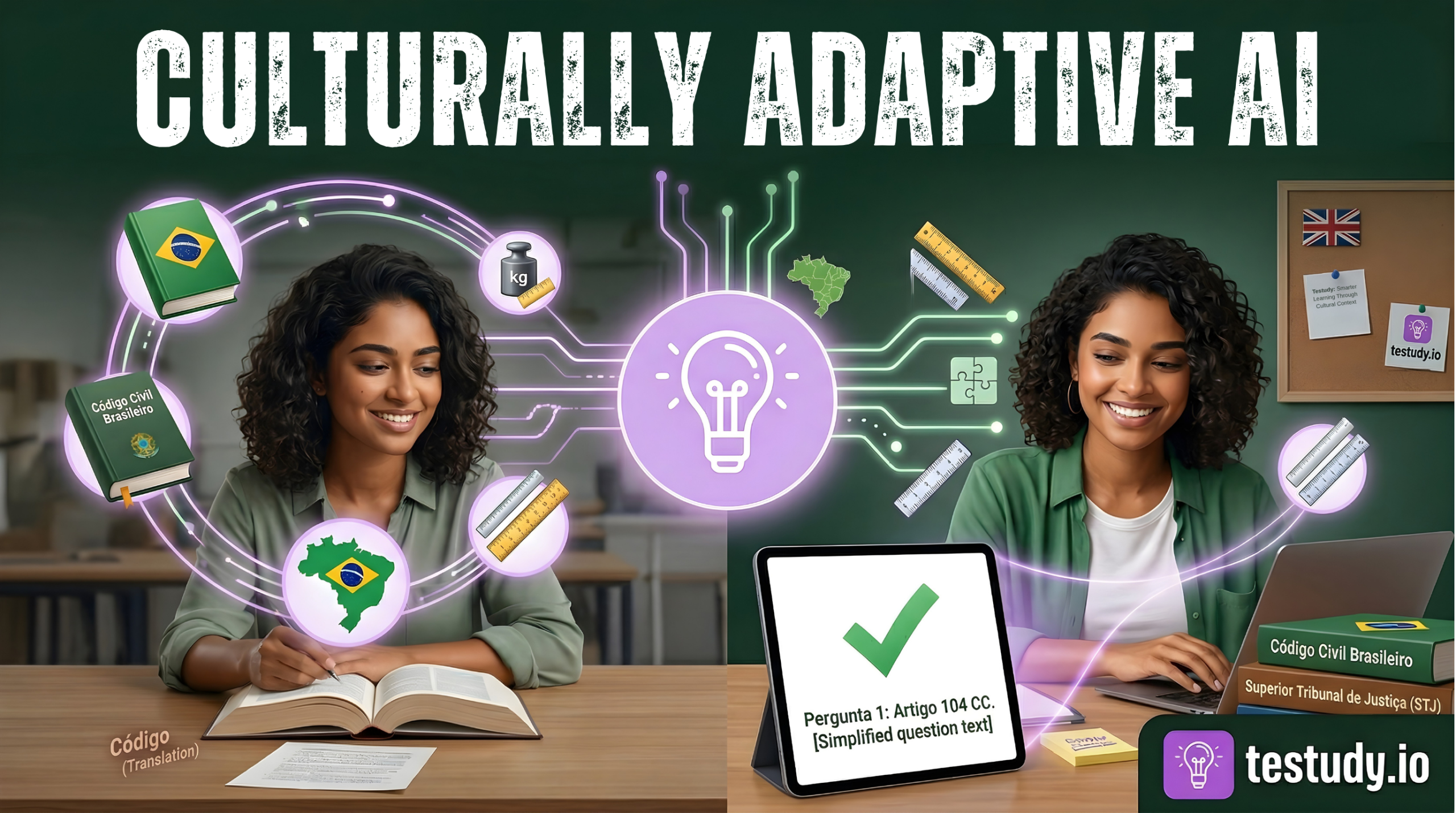
Imagine you’re a law student in Brazil reviewing a quiz on contract law. The question references ‘consideration’ in the context of a classic English common law case—a concept that doesn’t map directly to your civil law system. You understand the words, but the example feels alien, forcing you to mentally translate not just language but legal philosophy. This disconnect isn’t just inconvenient; it creates cognitive friction that hinders true mastery. Most AI learning tools today stop at translation, assuming that converting words is enough for global reach. But as we’ll see, that’s like expecting a map of New York to help you navigate Tokyo—the layout is familiar, but the landmarks, rules, and context are fundamentally different. Culturally adaptive AI moves beyond translation by embedding regional context, values, and familiar examples directly into the comprehension model. The result? Study materials that feel like they were designed for you, reducing extraneous cognitive load and accelerating retention. This isn’t about political correctness; it’s about learning efficiency. If your goal is mastery, the content must resonate at a cultural level, not just a linguistic one.
Why Translation Falls Short: The Cultural Nuance Gap
Translation is a necessary first step, but it’s insufficient for deep learning. Consider these common failure points: 1) Legal and Institutional References: A quiz question about ‘freedom of speech’ in a U.S. context might reference the First Amendment. Translated into German, the words are correct, but without explaining the U.S. constitutional framework versus Germany’s Grundgesetz approach, the learner misses the conceptual nuance. 2) Historical and Pop Culture Anchors: An example using ‘a Shakespearean tragedy’ to illustrate a literary device may not resonate in regions where Shakespeare isn’t part of the curriculum. The reference becomes a puzzle, not a mnemonic. 3) Colloquialisms and Idioms: Even with perfect translation, phrases like ‘hit the books’ (meaning to study) become literal and confusing. 4) Units and Systems: A math problem using miles, pounds, and Fahrenheit forces mental conversion, diverting attention from the core concept. The core issue is that translation preserves surface meaning but strips away the contextual scaffolding that makes information sticky. Cognitive load theory tells us that working memory is limited; when learners must simultaneously decode unfamiliar cultural references, they have fewer resources left for actual learning. This is where most people get stuck: they blame their own understanding, when in fact the material is culturally disjointed.
What Culturally Adaptive AI Actually Means
Culturally adaptive AI doesn’t just translate—it re-contextualizes. At its core, it means the AI model has been trained to recognize and generate content that aligns with a learner’s cultural frame of reference. This involves three layers: 1) Semantic Parsing Through a Local Lens: The AI doesn’t just identify keywords; it understands relationships within a cultural context. For instance, when generating a question about ‘democracy,’ it might pull examples from a learner’s local political history rather than defaulting to Athenian or American paradigms. 2) Example Domain Adaptation: Instead of using a default ‘John and Mary’ scenario, the AI generates names, settings, and scenarios that are common in the learner’s region—perhaps ‘Siti and Arif’ in a Malaysian context, with references to local festivals, foods, or social norms. 3) Value Alignment: Concepts like ‘individualism vs. collectivism’ can shape how scenarios are framed. A question about workplace conflict might emphasize team harmony in a collectivist context versus personal achievement in an individualist one. The adaptation happens at generation, not as a post-processing step. This requires the AI’s training data to include rich, region-specific corpora and for the model to have cultural metadata embedded. The payoff is reduced cognitive friction: learners encounter familiar patterns, freeing mental resources for higher-order thinking.
Building Region-Specific Understanding: Data and Model Training
The foundation of cultural adaptation is data—lots of it, and the right kind. Generic training data (mostly English, Western-centric) produces generic outputs. To build regional competence, you need: 1) Local Corpora Collection: This includes regional textbooks, newspapers, government documents, literature, and even social media conversations (with proper ethical sourcing). For example, training on the Indian ‘CBSE’ curriculum corpus helps the AI understand the examples and phrasing familiar to Indian students. 2) Metadata Tagging: Documents should be tagged with cultural metadata: country, language variant, educational system, historical period, etc. This allows the model to condition its outputs. 3) Balancing Breadth and Depth: You can’t cover every micro-culture, but you can target major regions (e.g., Southeast Asia, Latin America) and account for sub-regional variations through fine-tuning. 4) Challenges and Mitigations: Data scarcity in low-resource languages is a real problem. Solutions include partnering with local educational institutions, using synthetic data generation with extreme caution (to avoid bias amplification), and focusing initially on high-impact markets. The key is to treat cultural adaptation as a continuous data-gathering effort, not a one-off project. At Testudy, we’ve found that even a modest region-specific dataset—when properly curated and tagged—can dramatically improve relevance in quiz generation.
Adapting Example Domains for Local Relevance
Once the model understands context, it must generate appropriate examples. This adaptation spans several domains: – Legal and Governance Systems: Instead of always using U.S. Supreme Court cases, generate questions referencing the Federal Constitutional Court of Germany, the Supreme Court of India, or the Basic Law of Japan. The AI must know which legal principles apply where. – Historical and Cultural References: A history quiz for Nigerian learners should include the Biafra War or the Lagos Treaty; for Argentine learners, the May Revolution or the Dirty War. This doesn’t mean excluding global events, but balancing them with locally significant ones. – Everyday Contexts: A math problem about budgeting might use local currencies, common shopping items (e.g., ‘a kilogram of rice’ vs. ‘a pound of apples’), and familiar venues (local markets vs. supermarkets). – Social Norms and Values: Scenarios involving family decisions, workplace interactions, or community events should reflect local expectations. For instance, a question about ‘respect for elders’ might be framed within a collectivist family structure common in many Asian cultures. The adaptation must be seamless—the learner shouldn’t consciously notice ‘this is localized’ because it simply feels natural. This is where many systems fail: they add superficial local color (like changing names) but keep the underlying structure foreign. True adaptation re-engineers the scenario from the ground up.
Avoiding Cultural Bias Through Diverse Training Audits
Cultural adaptation isn’t just about adding local flavor; it’s about removing harmful biases. An AI trained on biased data can perpetuate stereotypes even when trying to be inclusive. For example, a ‘profession’ question might default to ‘nurse’ as female and ‘engineer’ as male across all cultures, which is inaccurate in many regions. To avoid this: 1) Diverse Training Data Audits: Regularly sample generated content and check for representation. Are all regions depicted equally? Are socioeconomic classes varied? Are indigenous cultures included? 2) Human-in-the-Loop Review: Employ local educators and cultural experts to review a subset of generated questions. They can spot subtle biases an AI might miss, like implying a certain religion is ‘default’ or depicting a region only in a poverty context. 3) Bias-Detection Tools: Use frameworks like IBM’s AI Fairness 360 or Google’s What-If Tool to statistically analyze outputs for skewed representations. 4) Feedback Loops: Allow learners to flag culturally inappropriate or inaccurate content. This data should directly feed into model refinement. 5) Transparency Reports: Publish (internally or externally) what cultural groups are covered, what biases were found, and how they’re being addressed. Trust is built not by claiming perfection, but by demonstrating rigorous, ongoing commitment to fairness. Remember: the goal is not to avoid all cultural reference—that’s impossible—but to ensure references are accurate, respectful, and representative.
Measuring Engagement Lift: From Theory to Proof
How do you know cultural adaptation is working? You need hard metrics. Implement controlled A/B tests: – Group A: Receives translated content (baseline). – Group B: Receives culturally adapted content. Track: 1) Completion Rates: Do learners finish more quizzes? 2) Retention Scores: Spaced repetition metrics—how well do they recall after days/weeks? 3) Time per Question: Faster response may indicate less cognitive friction. 4) Qualitative Feedback: Surveys asking ‘How relevant were the examples?’ and ‘Did you feel the material was designed for your context?’ 5) Drop-off Points: Where do learners abandon? Is it during questions with foreign references? At Testudy, we’ve seen engagement lifts of 15-25% in retention metrics for culturally adapted cohorts in non-English markets. But measurement must be nuanced: sometimes adaptation can backfire if done poorly (e.g., stereotyping). So also monitor negative feedback and error rates. The data should inform iterative improvement—cultural adaptation is not a set-and-forget task. Regularly update your models with new cultural trends and feedback.
Conclusion: The Path to Truly Global Learning Tools
Culturally adaptive AI represents the next evolution in global EdTech. Translation gets words across borders; cultural adaptation gets understanding into minds. By embedding regional context, values, and examples at the generation stage, we eliminate unnecessary cognitive friction, making learning more efficient and equitable. This requires investment in region-specific data, careful example design, rigorous bias audits, and continuous measurement. But the alternative—a world of study materials that feel perpetually foreign—is a barrier to true global knowledge sharing. For companies like Testudy, this isn’t just a technical challenge; it’s a commitment to respecting the diverse ways people learn. Start small: pick one high-potential market, build a local corpus, adapt a subset of content, measure rigorously. Learn, iterate, scale. The future of learning isn’t just multilingual—it’s multicultural. And that future begins with building AI that thinks, not just translates, in local contexts.
Conclusion
Culturally adaptive AI moves beyond the superficial act of translation to embed the deeper contextual frameworks that make learning stick. By training on region-specific data, adapting example domains, auditing for bias, and measuring real engagement, we create study tools that feel native to the learner’s world. This reduces cognitive load, improves retention, and builds trust. The technical implementation is complex, but the principle is simple: respect the learner’s context. For any EdTech platform aiming for global impact, this isn’t optional—it’s the foundation of effective education. Begin with a pilot, use data to guide you, and remember that the goal is not to create one-size-fits-all content, but to create content that fits the many sizes of human culture.
Food for Thought
Think of a study material you’ve used that felt ‘foreign’ even in your language. What specific examples or references felt out of place? How might they be adapted?
If you were to design a culturally adapted quiz for your own region, what three local references would you immediately include?
Consider your own learning: when you encounter an example from another culture, does it help you think more broadly, or does it create a mental hurdle? Why?
For educators: How comfortable are you with the idea of AI generating culturally specific content? What safeguards would you want in place?
Reflect on a time you learned a concept better because the instructor used a familiar analogy. What made that analogy effective? How could AI replicate that?
Frequently Asked Questions
How is cultural adaptation different from simple translation?
Translation converts words from one language to another. Cultural adaptation re-engineers the content’s context—examples, values, systems—to align with the learner’s cultural frame of reference. It’s the difference between translating a math problem about ‘miles’ to ‘kilometers’ and changing the scenario to use local currency, familiar locations, and common social situations. Adaptation happens at generation, not as an afterthought.
Isn’t this approach too expensive and complex for a startup?
It doesn’t have to be. Start with a high-impact market: pick one region, gather a modest but high-quality local corpus (textbooks, news articles), and adapt a single content type (e.g., legal quizzes). Use open-source bias-audit tools and partner with local universities for validation. The investment is incremental and data-driven; measure engagement lift to justify scaling. Many costs are one-time data collection, with ongoing refinement becoming cheaper.
How do we avoid cultural appropriation or offensive stereotypes when adapting content?
Three safeguards: 1) Work with local cultural experts and educators from the target region—they provide ground-truth. 2) Use diverse testing panels from that region to review generated content before deployment. 3) Implement bias-detection algorithms to flag potential stereotypes (e.g., over-representation of certain roles). The goal is accurate representation, not caricature. If unsure, default to neutral, globally understood examples until you can verify.
Can AI truly ‘understand’ culture well enough to do this reliably?
AI doesn’t ‘understand’ culture as humans do; it recognizes patterns in data. With sufficient, well-tagged regional data, it can generate contextually appropriate examples with high accuracy. However, human oversight is essential—especially for nuanced values and sensitive topics. Think of AI as a powerful pattern-matching tool that needs a human editor for cultural nuance. The system improves over time with feedback loops.
What if my audience is multicultural within one country (e.g., India, Nigeria)?
Segment by region, language, or educational board. For India, adapt separately for CBSE, ICSE, and state boards, as curricula and examples differ. Use learner profile data (location, language preference, declared curriculum) to serve the appropriate variant. You may need multiple regional models or fine-tune a base model per segment. Start with the largest segments and expand.
How often should we update our culturally adapted models?
Continuously. Culture evolves—new slang, historical reinterpretations, social changes. Set a quarterly review of training data to incorporate fresh local content. Monitor user feedback and engagement metrics for drops that might indicate outdated references. Treat cultural adaptation as a living component of your AI pipeline, not a one-time configuration.
Does this apply to all subjects equally?
No. Humanities, social sciences, law, and language learning benefit most, as they are rich in cultural context. STEM subjects may require less adaptation (e.g., math formulas are universal), but even there, word problems should use local units, currencies, and scenarios. Assess each subject area: the more it deals with human society, the more adaptation is needed.