Key Takeaways
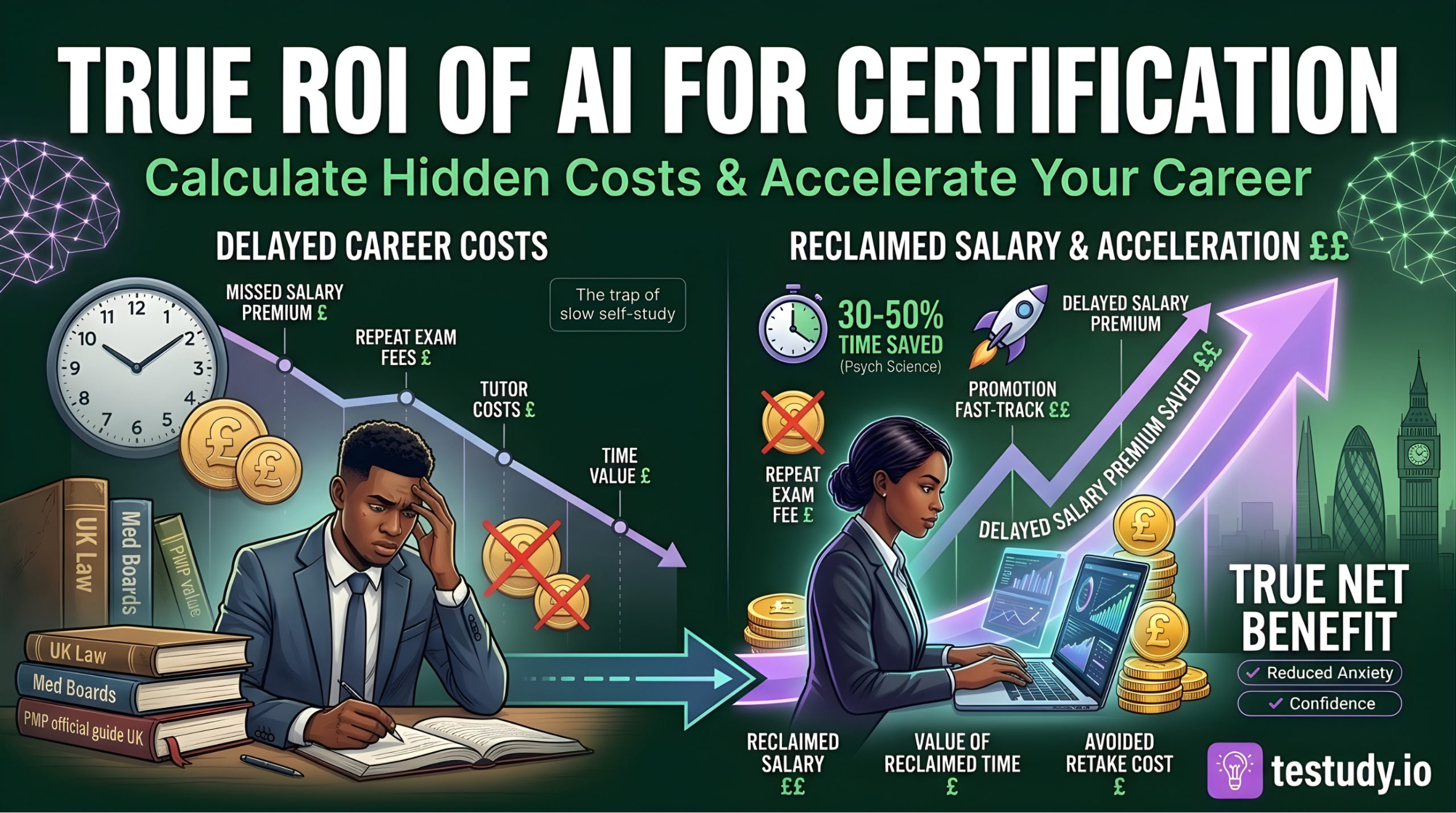
- The largest cost of certification prep is not the course fee; it is the opportunity cost of delayed career advancement and salary growth.
- AI study tools primarily save time by implementing cognitive science (spaced repetition, active recall) to make study hours more efficient, not necessarily by reducing total knowledge required.
- A proper ROI calculation must include hidden costs: repeat exam fees, tutor costs, and the monetary value of your study time.
- Your personal break-even point depends on your specific certification’s salary premium and your estimated time savings with the tool.
- Non-financial benefits, reduced anxiety, confidence from data-driven feedback, preserved career momentum, are significant and should factor into the decision.
Introduction
When evaluating an AI study tool for a professional certification, the most common question is, ‘How much does it cost per month?’ This is the wrong question. The more important question is: ‘What is the total cost of delay?’ For certification candidates—whether pursuing a PMP, bar exam, medical board, or any credential that impacts salary and career progression, every month spent inefficiently studying is a month of delayed promotion, missed salary increases, and prolonged professional stagnation. This article provides a framework for calculating the true return on investment (ROI) of AI-driven study platforms. We move beyond the sticker price to quantify the value of time saved, the cost of failed attempts avoided, and the acceleration of career advancement. The goal is not to sell you a tool, but to give you a clear, analytical model to determine if such a tool is a wise investment for your specific professional context.
Why Your Current ROI Calculation for Study Tools Is Probably Wrong
Traditional ROI calculations for educational products focus on input vs. output: cost divided by pass rate. This is a thin analysis. For a professional, the ‘output’ is not merely a passing score; it’s the timely acquisition of a credential that unlocks economic value. The primary flaw is ignoring opportunity cost—the financial and career benefits forgone by not having the certification sooner.
Consider this: a Project Management Professional (PMP) certification is associated with a salary premium of roughly 20% according to PMI’s 2023 salary survey. If the average project manager earns $110,000, that premium is $22,000 annually. If inefficient study methods add six months to your preparation timeline, the hidden cost is not the extra textbook you bought; it’s approximately $11,000 in delayed, higher earnings. An AI tool’s subscription fee is trivial compared to this figure. Therefore, the true ROI calculation must compare the tool’s cost against the total cost of delay it helps you avoid.
The Two Levers of AI Efficiency: Reducing Hours and Increasing Pass Probability
AI study tools like Testudy claim efficiency gains. These claims rest on two scientifically-grounded levers:
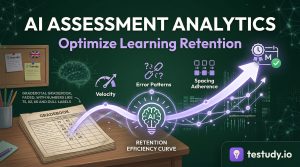
- Reducing Total Study Hours Required for Mastery: This is achieved through superior learning science implementation. Traditional self-study often involves passive re-reading, which is cognitively inefficient. AI platforms generate active recall quizzes (testing effect) and schedule reviews using spaced repetition algorithms. This means you spend less total time reviewing material you already know and more time on your knowledge boundaries. The result is a higher density of productive learning per hour. A meta-analysis in Psychological Science in the Public Interest estimates that spaced repetition can reduce required study time by 30-50% for long-term retention compared to massed practice (cramming).
- Increasing First-Try Pass Probability: By focusing your study on weak areas identified through continuous quizzing and eliminating ‘fluff’ from your materials, these tools increase the efficiency of your preparation toward the specific exam blueprint. A higher first-attempt pass rate directly eliminates the massive hidden costs of a retake: another exam fee ($200-$500+), additional study time, and further delayed career progression.
The value proposition is this: you are not buying a content library; you are buying a optimized process that attacks the two largest sources of waste in your certification journey: unproductive study hours and failed exam attempts.
Itemizing the Hidden Costs of Traditional Certification Prep
To build a complete model, we must list all cost categories. Most candidates only tally obvious expenses.
Direct Financial Costs:
- Exam registration fees
- Official prep course or bootcamp tuition
- Third-party study books and question banks
- Potential tutor/coach fees
- Costs for updated materials if the exam blueprint changes
Indirect Financial & Opportunity Costs:
- Value of Study Time: Assign an hourly value to your time (e.g., your billable rate, or a conservative $30-$50/hr). Multiply by estimated total study hours.
- Cost of Delay: The present value of the salary premium, bonus eligibility, or promotion you miss out on for each month your certification is postponed. This is often the largest number.
- Repeat Exam Costs: The full financial and time cost of a retake, including potential rescheduling fees.
- Paid Leave/Vacation Days Used: If you take time off work to study or test, that is a real cost.
Psychosocial Costs (Harder to Quantify but Real):
- Prolonged stress and anxiety affecting job performance and health.
- Loss of professional confidence during the prolonged ‘in-progress’ status.
- Opportunity cost of not applying for jobs that require the credential.
A simple spreadsheet that sums these categories for a ‘traditional’ path provides the baseline total cost against which an AI tool’s subscription cost (plus any minimal setup time) is compared.
Case Study Breakdown: Concrete Numbers from PMP, Law, and Medical Candidates
Let’s ground this in reported data. While Testudy’s specific user data is proprietary, we can construct realistic scenarios based on industry averages and anonymized testimonials.
Scenario A: The PMP Candidate
- Traditional Path: 350 study hours over 7 months. 1st attempt pass rate ~60% for self-study. Cost: $2,500 (course + books), ~$10,500 in time value ($30/hr).
- AI-Tool Path: 200 study hours over 4 months. 1st attempt pass rate ~85% (based on platform claims and cognitive science). Cost: $300 (6-month subscription), ~$6,000 in time value.
- Net Impact: Saves 150 hours ($4,500 value), avoids 40% chance of a $2,500+ retake, and achieves certification 3 months sooner. The ‘cost of delay’ saved, using a $20k/yr premium, is ~$5,000. Total financial benefit: ~$11,500 vs. $300 tool cost.
Scenario B: The Bar Exam Candidate
- Traditional Path: 600+ hours over 3-4 months. High-stress, high attrition. Cost: $3,000 (bar prep course), ~$18,000 in time value.
- AI-Tool Path: 450 hours (focusing on memorization-intensive MBE rules via active recall). Cost: $300. Saves 150 hours ($4,500) and significantly reduces the psychological cost of the ‘grind.’ The accelerated bar admission could mean starting legal practice 1-2 months earlier, a massive financial win.
Key Insight: The absolute time savings (150 hours) are similar across domains, but the monetization of that saved time varies dramatically based on the candidate’s earning potential and the salary premium of the credential.
Building Your Own Break-Even Analysis: A Step-by-Step Framework
You cannot rely on generic case studies. You must calculate for your context. Here is a simplified framework:
- Estimate Your Traditional Total Cost (TTC):
TTC = (Exam Fees + Course/Book Costs) + (Your Hourly Rate * Estimated Traditional Study Hours) + (Probability of Failure * Cost of Retake). - Estimate Your AI-Tool Total Cost (ATC):
ATC = (Tool Subscription Cost for Expected Duration) + (Your Hourly Rate * Estimated Setup/Onboarding Hours). Assume a 20-40% reduction in total study hours. - Calculate Gross Savings:
Gross Savings = TTC – ATC. - Factor in Opportunity Cost of Delay (OCD):
This is the most critical step. OCD = (Monthly Certification Premium) * (Months Saved by Using Tool).- To find Monthly Premium: (Certified Salary – Uncertified Salary) / 12.
- To find Months Saved: (Traditional Timeline – AI-Tool Timeline).
- True Net Benefit:
True Net Benefit = Gross Savings + OCD.
Example: If your tool saves you 3 months and your monthly premium is $1,000, the OCD is $3,000—far exceeding any subscription cost. This is the number that converts cost-conscious professionals.
The Non-Financial ROI: Confidence, Reduced Anxiety, and Career Momentum
A purely financial model is incomplete. The intangible ROI for certification candidates is substantial:
- Confidence Through Mastery Verification: AI-generated quizzes provide constant, objective feedback. This replaces the anxiety of ‘Do I know this?’ with data-driven certainty (‘I scored 90% on this domain’). This confidence translates to better exam performance and reduced second-guessing.
- Reduced Decision Fatigue: A step-by-step learning roadmap eliminates the daily question, ‘What should I study today?’ This mental overhead is a hidden tax on willpower and focus.
- Preservation of Career Momentum: By shortening the certification window, you maintain your professional narrative and avoid the ‘professional pause’ that can stall momentum for raises or new opportunities.
These factors contribute to a higher likelihood of not just passing, but excelling in your subsequent role, creating a compounding effect on your career trajectory that is difficult to overstate.
Conclusion: From Cost Center to Career Accelerator
The true ROI of an AI study tool for a certification candidate is not found in a per-month cost comparison. It is found in the sum of: the direct financial savings from avoided retakes and reduced material purchases; the immense value of reclaimed time; and, most critically, the acceleration of career advancement quantified as the ‘cost of delay’ avoided. When framed this way, a $200-$400 subscription transforms from a ‘study expense’ into a ‘career acceleration investment’ with a potential payoff in the tens of thousands of dollars.
The final step is personalization. Use the framework above with your specific numbers—your target certification’s salary premium, your estimated study efficiency, your hourly rate. The result will tell you, with clarity, whether this technology is a strategic tool for your professional goals or an unnecessary cost. For those seeking to automate the calculation, an interactive ROI calculator based on this model is the logical next tool to build or use.
Conclusion
In summary, evaluating AI study tools through the narrow lens of subscription cost is a fundamental error for the certification candidate. The correct framework centers on Total Cost of Delay. By quantifying the financial impact of prolonged study timelines, failed attempts, and inefficient hours, and contrasting it with the modest, fixed cost of an efficiency tool, the ROI becomes overwhelmingly clear for most time-poor professionals. The investment is not in the software; it’s in the months of career progression you reclaim. Calculate your numbers, challenge your assumptions about ‘study costs,’ and make a decision based on the true economics of your professional advancement.
Food for Thought
If you added up all the hours you expect to study for your exam, what is that time worth to you at your target (or current) hourly rate?
What is the monthly salary increase or bonus eligibility you anticipate from your certification? How many months of that premium would equal the cost of a year-long AI study tool subscription?
Think about your last major learning project. Where did you waste the most time: re-learning forgotten material, studying irrelevant content, or unsure what to focus on next?
If you could guarantee a 30% reduction in your total study time with no drop in comprehension, what would you do with those reclaimed months?
Beyond the passing score, what does ‘being ready’ for this certification feel like to you? How might a structured, adaptive plan change that feeling?
Frequently Asked Questions
Is this ROI model valid if I’m not currently employed or don’t have a specific salary increase lined up?
Yes, but the calculation changes. Your ‘hourly rate’ for valuing study time should reflect your target salary post-certification divided by your expected working hours. The ‘opportunity cost of delay’ becomes the difference between starting your target role now versus in six months. For job seekers, the value is in entering the candidate pool sooner, which has real economic value even without a current employer’s raise structure.
What if I’m a slow learner or need to deeply understand complex concepts? Can an AI tool still save me time?
The time savings are most pronounced for the review and retention phase, not the initial deep learning. AI tools excel at optimizing the process of moving knowledge from short-term to long-term memory via spaced repetition and identifying precisely what you have and haven’t mastered. For initial concept acquisition, you still need textbooks, courses, or mentors. The tool ensures your subsequent study time is hyper-focused on your actual gaps, preventing the common inefficiency of re-studying material you already know.
How do I realistically estimate my ‘traditional study hours’? I always underestimate.
Use a ‘time diary’ approach for one week of your current study. Log every minute spent. Multiply by the number of weeks you actually expect to study (be honest, not optimistic). Alternatively, use industry averages from certification bodies or forums (e.g., ‘Most PMP candidates report 300-400 hours’). Pad that estimate by 20% to account for unforeseen complexities. It’s better to overestimate the traditional cost, as it makes your potential savings more conservative and the conclusion more robust.
Are the case study numbers (e.g., 150 hours saved) typical, or are they best-case scenarios?
The cited savings (30-40% reduction) are aligned with the established efficacy of spaced repetition and active recall over passive review. However, the realized savings for an individual depend entirely on two factors: 1) the quality and structure of the source material uploaded into the AI, and 2) the user’s consistency in following the generated plan. A disorganized user who ignores the tool’s recommendations will see minimal benefit. The numbers represent the potential under optimal engagement.
What about data privacy? I’m uploading my study materials and quiz performance to an AI platform.
This is a critical and valid concern. You must review the tool’s privacy policy and terms of service. Key questions: Is your data used to train their public models? Can you permanently delete your data? Where is it stored (GDPR compliance for EU users)? Reputable platforms will have clear, accessible answers to these questions. Treat your study materials as proprietary; understand the data license you are granting. This due diligence is part of your total cost calculation.