Key Takeaways
- Testudy’s quality control relies on a mandatory human SME review layer; AI alone is not trusted for final content.
- Fact-checking is source-anchored and involves a verification protocol that re-solves problems and checks paraphrases.
- Bias detection includes content framing, cultural sensitivity, and misinformation, not just demographic stereotypes.
- Questions are explicitly aligned to Bloom’s Taxonomy levels, and this alignment is validated by SMEs to ensure proper cognitive targeting.
- User feedback directly feeds into model retraining, creating a continuous improvement cycle.
- Transparency is enforced through quarterly public reports on error rates, correction times, and review coverage.
Introduction
The promise of AI in education is immense: instant quiz generation, personalized learning paths, and the elimination of busywork. But for educators and institutions, that promise is tempered by a critical question: can we trust the content? If you’ve ever encountered an AI-generated fact that was subtly wrong, a question that favored a particular cultural viewpoint, or a quiz that tested rote memorization instead of deep understanding, your skepticism is not just valid, it’s essential. At Testudy, we believe that AI-generated quizzes are only as good as the quality control systems that govern them. This article pulls back the curtain on our rigorous, multi-layered quality assurance process. We don’t just generate questions; we subject every output to a hybrid human-AI validation pipeline designed to ensure factual accuracy, eliminate harmful bias, and align with proven pedagogical principles like Bloom’s Taxonomy. Our goal is not to convince you that AI is infallible, but to demonstrate exactly how we build reliability into every step, making our platform a trustworthy partner for high-stakes learning.
1. The Hybrid Human-AI Validation Pipeline: Our Core QA Architecture
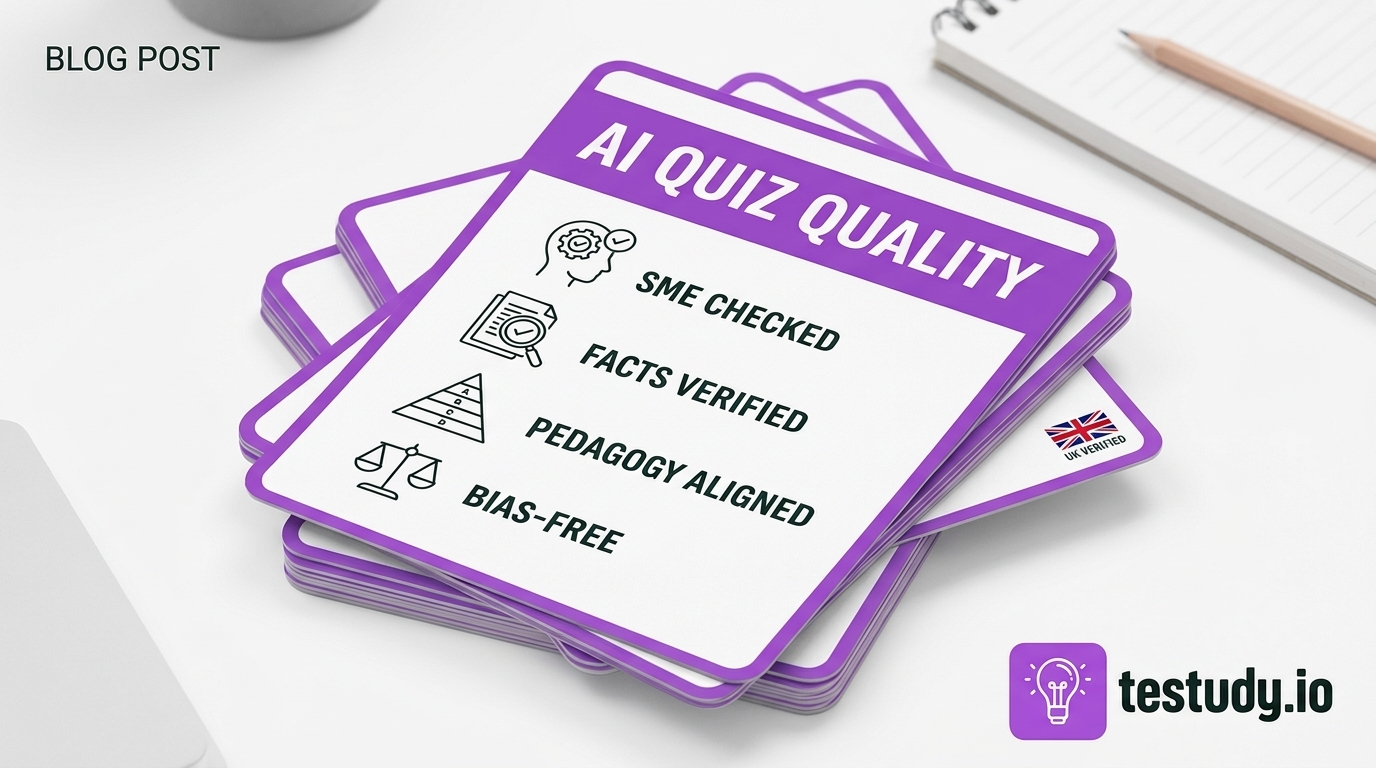
The foundation of our quality control is a deliberate hybrid model. We reject the false dichotomy of ‘fully automated’ versus ‘entirely manual.’ Instead, we treat AI and human expertise as complementary forces. The pipeline works as follows: First, our AI comprehension engine processes your source text (a textbook chapter, article, or lecture notes) and generates a draft set of quiz questions and answers. This initial pass focuses on coverage and pattern recognition. Second, and critically, every question batch is routed to a certified Subject Matter Expert (SME). These are not generalists; they are professionals with advanced degrees and teaching experience in the specific domain (e.g., a PhD in Neuroscience for medical material, a certified ESL instructor for language learning). The SME’s mandate is threefold:
1) Factual Verification: Cross-check every claim, date, formula, and definition against the source material and authoritative references.
2) Clarity & Ambiguity Check: Ensure questions are unambiguous, answers are distinct, and distractors (wrong answers) are plausible but incorrect.
3) Pedagogical Flagging: Identify questions that may be too trivial, too complex, or misaligned with the likely learning objective. Only after SME approval does a question enter your active study pool. This human-in-the-loop step is non-negotiable for us; it is the primary filter that catches the nuanced errors AI inevitably makes.
2. Fact-Checking Mechanisms and Source Verification
How do we ensure the AI’s ‘comprehension’ translates to factual accuracy? Our system employs a multi-pronged fact-checking mechanism.
A: Source Grounding. The AI is constrained to extract information only from the provided source text. It cannot incorporate external ‘knowledge’ from its training data that isn’t present in your material. This prevents the introduction of outside facts or outdated information.
B: Internal Consistency Scoring. The model generates a confidence score for each fact it extracts. Low-confidence statements (e.g., based on a single, poorly phrased sentence in the source) are automatically flagged for mandatory SME review.
C: SME Verification Protocol. SMEs use a standardized checklist. They verify: 1) Direct quotation accuracy, 2) Paraphrase fidelity (does the question’s premise match the source’s meaning?), and 3) Answer correctness, especially for multiple-choice questions with ‘all of the above’ or ‘none of the above’ options. For quantitative subjects (math, physics, chemistry), we require SMEs to re-solve problems. For qualitative subjects (history, literature, law), SMEs check for misrepresentation of arguments or contexts. This is where we catch what the AI misses: a subtle shift in meaning, a misapplied term, or a historical event presented out of chronological context.
3. Bias Detection: Beyond Demographic Stereotypes
When we say ‘bias detection,’ we mean more than just avoiding offensive stereotypes (though that is part of it). Educational bias manifests in three key areas we actively screen for:
1. Content & Framing Bias: Does a question about ‘economic development’ only use examples from Western nations? Does a case study in business ethics only feature male executives? Our SMEs are trained to spot a lack of diverse perspectives or the implicit presentation of one viewpoint as universal.
2. Cultural Sensitivity & Context: A question that is neutral in one culture may be loaded in another. For language learners, this includes idiomatic expressions that carry unintended connotations. Our review process includes a cultural sensitivity checklist, particularly for content aimed at a global audience.
3. Misinformation & Controversy: This is a major pitfall. If your source text contains a disputed claim or outdated theory, an AI will happily generate a ‘correct’ answer based on it. Our SMEs are tasked with identifying such content. They don’t correct the source (that’s your role), but they can flag the question for your review or add a disclaimer note. For example, a psychology text citing an outdated model of memory would generate questions that are ‘factually correct’ relative to the source but scientifically obsolete. The SME’s job is to catch this and escalate it. This layer of review is what separates pedagogically sound material from potentially harmful or misleading content.
4. Pedagogical Soundness: Aligning Questions with Learning Objectives (Bloom’s Taxonomy)
A factually correct question can still be a poor learning tool. Pedagogical soundness is about why you’re asking the question. We explicitly align our quiz generation with Bloom’s Taxonomy of cognitive domains, a framework from Remembering’ (lowest) to ‘Creating’ (highest).
Our Alignment Process:
a) AI Tagging: The initial AI pass attempts to classify the cognitive level of each generated question based on verb analysis (e.g., ‘define’ = Remember, ‘compare’ = Analyze).
b) SME Validation & Adjustment: The SME reviews this classification. This is crucial—the AI often misclassifies. A question asking ‘What are the steps of the scientific method?’ is clearly ‘Remember.’ But a question asking ‘Design an experiment to test X hypothesis’ should be ‘Create.’ The SME re-tags it and may rewrite the question to better serve the target level.
c) Learning Path Integration: This alignment isn’t just academic. It directly feeds into our adaptive learning paths. A student struggling with ‘Application’ questions will be served more ‘Application’ and ‘Analysis’ questions before moving to higher levels. We ensure that your study roadmap doesn’t skip foundational levels or jump ahead prematurely. We also enforce balance: a chapter on a complex theory should generate a mix of levels, not just recall questions. This focus on cognitive alignment ensures the quiz is a tool for mastery, not just recognition.
5. Continuous Improvement: User Feedback Loops and Model Retraining
Our QA system is not static; it’s a learning loop. The most powerful quality signal comes from you. Every user has a ‘Report an Issue’ button on every question. When a user reports an error (factual, biased, poorly worded), it enters a triage system.
a) Triage: Our internal QA team (composed of former educators) assesses the report.
b) SME Verification: The report is sent to an appropriate SME for the domain. They confirm the error, correct the question, and categorize the error type (e.g., ‘factual inaccuracy,’ ‘ambiguous wording,’ ‘bias’).
c) Correction & Deployment: The corrected question is instantly updated in the user’s study session and in the master question bank. d) Model Retraining: Aggregated, anonymized error data is fed back into our AI training pipeline. If a specific type of question (e.g., historical date questions from 19th-century European history) has a high error rate, we use that data to fine-tune the model for that content genre. This creates a virtuous cycle: more usage leads to more feedback, which leads to a smarter, more accurate AI. It also means our error rates should trend downward over time as the model learns from its specific mistakes in your content domains.
6. Transparency and Accountability: Publishing Our Error Metrics
Trust is built on transparency, not marketing claims. We are committed to publishing a quarterly ‘Transparency Report’ on our quality metrics. This report will detail: .
a) Factual Error Rate: The percentage of questions that required correction post-SME review (our target is <0.5%).
b) SME Review Coverage: The percentage of all generated questions that undergo mandatory SME review (100% for institutional clients; a statistically significant sample for individual users).
c) Bias Flag Rate: The percentage of questions flagged by SMEs for potential content or cultural bias, with breakdowns by category.
d) Correction SLA: Our average time from user report to question correction (target: <48 hours for critical factual errors).
e) Bloom’s Alignment Accuracy: The rate at which AI-tagged question levels match final SME-assigned levels. We will also detail any known limitations. For example, our system is optimized for standard academic English source material. Highly poetic, archaic, or non-standard dialects may yield lower comprehension and higher error rates, which we will disclose. This level of reporting is rare in EdTech and is our answer to the ‘black box’ problem of AI. You deserve to know the machinery’s performance, not just its promise.
Conclusion: Building Trust Through Process, Not Promises
The question of quality in AI-generated education is not a technical footnote; it is the central issue. A tool that saves time but propagates errors or subtle biases is a liability, not an asset. At Testudy, our engineering and editorial resources are disproportionately invested in the quality control layers described above. We believe that for AI to be viable in high-stakes educational settings—from professional certification to medical board exams, it must pass a higher bar. That bar is a transparent, hybrid validation pipeline where subject matter experts are the final arbiters of accuracy and pedagogical value. It is a system that embraces feedback, publishes its metrics, and continuously retrains. This approach doesn’t just make better quizzes; it builds a foundation of trust. When you use Testudy, you are not gambling on an unverified algorithm. You are leveraging a system designed with the same rigor you would expect from a human-curated study guide, scaled by intelligent automation. The goal was never to replace the educator’s discernment, but to amplify it, freeing you to focus on teaching while we handle the meticulous work of ensuring the material itself is worthy of your students’ time.
Conclusion
Ultimately, the effectiveness of any study tool hinges on the quality of its content. By implementing a rigorous, transparent, and hybrid QA process—combining AI efficiency with deep human expertise. Testudy sets a new standard for reliability in AI-powered education. We invite you to review our public transparency reports, examine our SME credentials, and experience the difference that disciplined quality control makes. The future of learning is intelligent, but it must first be trustworthy.
Food for Thought
Consider the study materials you use most often. What specific types of errors (factual, biased, pedagogically weak) have you encountered that most disrupted your learning or trust in the material?
If you were to implement a quality control process for your own study notes or teaching materials, which step in Testudy’s pipeline (SME review, bias check, Bloom’s alignment) would you prioritize and why?
Think about a subject you know well. Where do you think current AI comprehension models would most likely fail to generate accurate or appropriate questions for that domain?
The article emphasizes a ‘hybrid’ model. In your experience, what tasks in education are best suited for pure automation, and which absolutely require human judgment?
Transparency reports are proposed as a trust-building measure. What specific metric would be most meaningful to you as an educator or learner when evaluating an AI tool’s reliability?
Frequently Asked Questions
How do you define and vet your Subject Matter Experts (SMEs)?
Our SMEs are rigorously vetted professionals. They typically hold an advanced degree (Master’s or PhD) in their field and have documented teaching or curriculum development experience (e.g., university instructor, certified trainer, lead editor for academic publishers). We verify credentials and conduct a comprehensive onboarding on our specific QA protocols, bias detection guidelines, and Bloom’s Taxonomy application. For highly specialized fields (e.g., neurosurgery, patent law), we engage SMEs with current, active practice in addition to academic credentials.
What is your actual factual error rate, and how is it calculated?
We calculate our factual error rate as (Number of questions requiring post-SME correction) / (Total questions reviewed by SMEs) x 100. Our target for new content generation is <0.5%. This metric is published quarterly in our Transparency Report, broken down by content category where possible. It’s important to note this measures errors caught by our process. It is not an estimate of errors that might slip through to a final user, which is a separate, lower metric we also track via user reports.
How does the system handle controversial or rapidly evolving topics (e.g., current events, emerging science)?
This is a key challenge. Our AI is constrained to the source text you provide. If your source is a textbook published in 2020 on a fast-moving topic like COVID-19, the AI will generate questions based on that 2020 information. Our SME review process is designed to flag such content as ‘potentially dated’ or ‘subject to ongoing debate.’ We do not automatically update questions based on new external information, as that would violate the source-grounding principle. Instead, we flag it for your attention. The recommendation for users is to use Testudy with source materials that are stable and authoritative for the learning objective. For current events, a curated news source updated by an educator is a better input than a static AI summary.
Can I see the SME’s corrections or comments on my generated questions?
For individual users, we provide a high-level summary of corrections (e.g., ‘This question was adjusted for clarity’). For institutional clients (universities, corporations), we offer a detailed audit log. This log shows the original AI-generated question, the SME’s edits, the reason for the edit (e.g., ‘factual verification,’ ‘bias flag’), and the SME’s anonymized ID. This level of transparency is part of our institutional service tier and is designed for curriculum committees or compliance officers who need to validate the assessment quality.
How does Testudy’s quality control compare to simply having an educator write all questions themselves?
The goal is not to replace educator-written questions for high-stakes, final exams. Our strength is in the formative assessment space—practice quizzes, chapter reviews, and self-check exercises where volume and rapid iteration are valuable. Our hybrid process aims to achieve a quality level approaching that of a dedicated educator writing all questions, but at a fraction of the time. The trade-off is clear: for a final summative exam, a human expert’s bespoke questions are likely superior. For generating dozens of high-quality, pedagogically aligned practice questions from a 50-page chapter, our system provides a scalable alternative that maintains rigorous standards through the SME review layer. We see ourselves as a powerful assistant, not a replacement, for the educator’s expertise in summative design.