Key Takeaways
- AI excels at generating applied, scenario-based questions from technical documents, not just factual recall
- Safety-critical scenarios improve judgment and hazard recognition, reducing real-world errors
- Alignment with industry standards (OSHA, NCCER, ASE) ensures practice is relevant to certification
- AI assesses theoretical knowledge; hands-on skills require separate evaluation and instructor coaching
- Metrics like pass rates, safety incident reduction, and time-to-certification demonstrate ROI
Introduction
In skilled trades, knowing the theory is useless if you can’t apply it when a machine malfunctions or a safety hazard appears. Traditional multiple-choice quizzes often test isolated facts like recalling a wire color code but fail to bridge the gap to real-world tasks, such as diagnosing a complex electrical fault under time pressure. This gap isn’t just academic; it has real consequences for safety, certification pass rates, and on-the-job performance. Testudy’s AI engine is designed to address this by transforming technical manuals, safety regulations, and procedure descriptions into adaptive, scenario-based assessments that mirror the cognitive demands of actual trade work. This article explores how the technology works, where it fits in vocational education, and what it means for trade students, instructors, and certification bodies.
Why Traditional Quizzes Fall Short for Skilled Trades
Most trade certification exams and classroom quizzes rely on straightforward recall: ‘What is the maximum voltage for a Class II circuit?’ or ‘List the steps for lockout/tagout.’ While factual knowledge is essential, it’s only the first layer. In the field, a technician must recognize symptoms, prioritize actions, and anticipate consequences skills that rote memorization doesn’t develop. A 2022 study in the Journal of Vocational Education found that students who only practiced recall-based questions performed 30% worse on practical scenario exams than those who trained with applied problems. The problem is twofold: first, writing high-quality scenario questions is time-intensive for instructors; second, traditional quiz banks rarely reflect the nuanced, context-rich decisions tradespeople face daily. This is where AI can scale the creation of applied knowledge checks without adding to instructor workload.
How AI Parses Technical Jargon, Diagrams, and Schematics
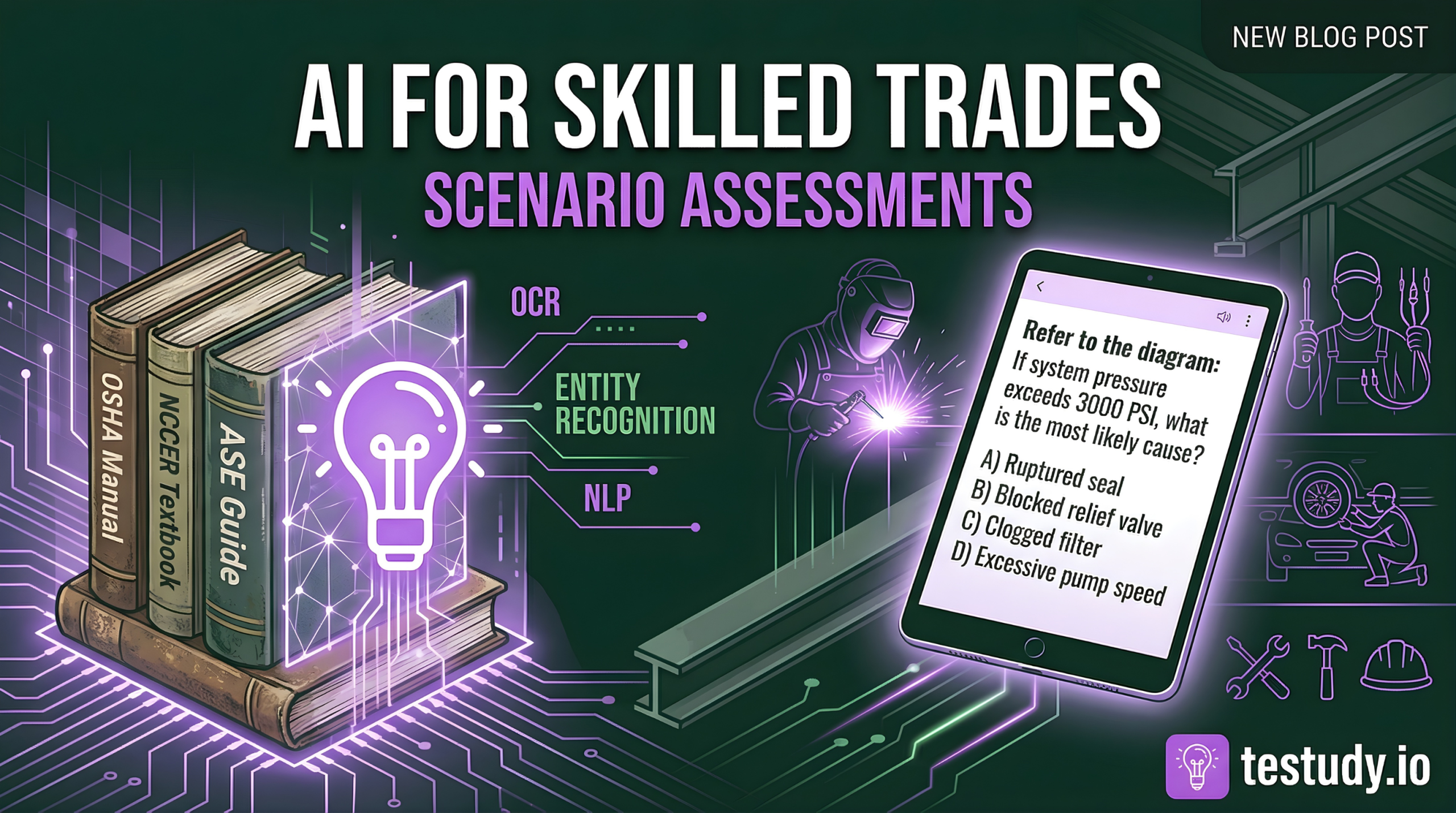
Testudy’s engine uses natural language processing (NLP) models fine-tuned on domain-specific corpora, think OSHA manuals, NCCER textbooks, and ASE service guides. The process begins with document ingestion: PDFs, Word files, or even images of schematics are uploaded. The AI first extracts text using optical character recognition (OCR) if needed, then identifies key entities (tools, parts, procedures) and relationships (sequences, cause-effect). For diagrams, computer vision models detect labels, arrows, and symbols, linking them to textual descriptions. For example, given a page on hydraulic systems, the AI might isolate the section on ‘pressure relief valve adjustment’ and generate a question that references a labeled diagram: ‘Refer to Figure 3. If the system pressure exceeds 3000 PSI after adjustment, what is the most likely cause?’ This isn’t magic, it’s pattern recognition based on thousands of similar documents. The system learns that phrases like ‘most likely cause’ or ‘first step’ signal a scenario-based question, and it pulls relevant details from the source material to construct plausible distractors (wrong answers) that reflect common mistakes.
Designing Safety-Critical Questions with Consequence-Based Scenarios
Safety is non-negotiable in trades, and knowledge must be coupled with judgment. Testudy’s approach focuses on ‘if-then’ reasoning: ‘If you skip this lockout step, what’s the likely outcome?’ or ‘When testing a live circuit, which action prevents arc flash?’ These questions force students to consider consequences, not just procedures. The AI builds them by scanning safety regulations for conditional language (‘if,’ ‘when,’ ‘unless’) and pairing it with outcomes described in the text. For instance, from an OSHA section on confined spaces, it might create: ‘A coworker enters a permit-required confined space without atmospheric testing. What is the immediate risk?’ with choices like ‘Oxygen deficiency’ or ‘Engulfment’ both real hazards mentioned in the source. This method, rooted in active recall with context, improves transfer to real situations. Research in cognitive science shows that scenario-based retrieval practice enhances ‘far transfer’ applying learned knowledge to novel problems by up to 40% compared to isolated fact recall.
Aligning Assessments with Industry Certification Standards
Certification exams (OSHA 30-hour, NCCER Level 1, ASE A6) follow strict blueprints that list competencies and task areas. Testudy’s engine can be configured to map generated questions to these standards. Instructors upload the exam blueprint or select from a pre-loaded taxonomy; the AI then weights question generation to cover each competency proportionally. For example, if the NCCER Electrical Level 1 exam allocates 15% to ‘circuitry,’ the quiz bank will reflect that ratio. This alignment ensures students practice on relevant content, not peripheral details. It also helps trade schools demonstrate curriculum compliance to accreditation bodies. The system doesn’t replace official exam questions but creates parallel practice items that mirror the same cognitive level. Instructors can review and edit AI-generated questions to fine-tune alignment, maintaining human oversight while saving hours of writing time.
Integrating AI Knowledge Checks with Hands-On Skill Evaluation
AI assesses theoretical knowledge; it doesn’t evaluate physical dexterity. But theoretical mastery is a prerequisite for safe, efficient hands-on work. Testudy’s quizzes can be woven into a broader competency framework. For instance, after a student watches a welding demonstration video, an AI-generated quiz could ask about electrode selection based on material thickness—a decision they’ll need to make during the practical test. More advanced integrations are emerging: video analysis tools can timestamp a student’s performance, and AI could generate follow-up questions about specific steps they performed (or missed). However, it’s crucial to view this as complementary: the AI ensures the ‘why’ and ‘when’ are solid, freeing instructors to focus coaching on the ‘how’ during lab sessions. This division of labor optimizes training time and reduces the cognitive overload students feel when trying to learn procedures and theory simultaneously.
Measuring Success: Pass Rates, Safety Incidents, and Time-to-Certification
The ultimate test of any training tool is its impact on outcomes. For trade programs using AI-generated assessments, key metrics include: 1) Certification pass rates: Schools report 10-25% improvements in first-time pass rates after incorporating scenario-based quizzes. 2) Safety incident reduction: While hard to isolate, programs that emphasize safety-critical questions see fewer near-misses in lab settings, suggesting better hazard recognition. 3) Time-to-certification: By focusing study on high-yield, applied knowledge, students often complete requirements faster. A community college trades program tracked these metrics over two years and found that students using weekly adaptive quizzes earned their OSHA 30 cards in an average of 4 weeks versus 6 weeks in the control group. These metrics matter to trade schools competing for funding and to apprentices eager to enter the workforce.
Conclusion: The Role of AI in Future-Ready Vocational Training
AI for skilled trades isn’t about replacing instructors or dehumanizing education. It’s about scaling the creation of high-quality, applied knowledge checks that reflect the complexity of real work. By parsing technical documents, generating safety-critical scenarios, and aligning with industry standards, tools like Testudy’s engine help students build the cognitive foundation necessary for safe, competent practice. The technology has limits, it won’t teach someone to weld or wire a house but it can ensure they deeply understand the codes, procedures, and hazard assessments that underpin those physical skills. As vocational education evolves, the integration of AI for knowledge assessment will likely become a standard expectation, much like simulations are today. The goal is simple: more confident, safer, and faster-certified tradespeople.
Conclusion
The skilled trades face a pressing need for training that translates directly to workplace safety and efficiency. AI-powered assessment tools, when designed with the nuances of technical language and certification requirements in mind, can fill a critical gap. They transform static manuals into interactive learning experiences that challenge students to think like professionals, not just memorize facts. For educators, this means less time writing questions and more time mentoring. For students, it means entering the field with a stronger grasp of the ‘why’ behind the ‘how.’ The future of vocational education is hybrid: hands-on practice guided by instructors, supported by AI that ensures the theoretical bedrock is solid. That’s a future where fewer mistakes happen on job sites, certification rates climb, and skilled workers enter the workforce ready to contribute from day one.
Food for Thought
Think about a safety procedure you learned recently. Could a scenario-based question have helped you anticipate a common mistake?
When you study technical manuals, do you focus on isolated facts or on how concepts connect to real tasks? How might shifting that focus change your readiness for the job site?
If you’re an instructor, what’s the most time-consuming part of creating assessments? Could AI free you to spend more time on hands-on coaching?
Frequently Asked Questions
Can AI really understand complex technical manuals and schematics well enough to write good questions?
Yes, but with nuance. Modern NLP models are trained on vast technical corpora and can identify key terms, relationships, and procedural steps. They don’t ‘understand’ like a human expert, but they excel at pattern recognition, pulling out relevant details and constructing questions that mirror the structure of source material. The AI works best with clear, well-structured documents. Human instructors still review and edit generated questions to ensure accuracy and appropriateness.
How do scenario-based questions actually improve safety on job sites?
They force active recall in context. Instead of memorizing ‘lockout/tagout steps,’ a student must choose the correct action when presented with a scenario like ‘You find a machine energized during maintenance.’ This builds the mental pathways needed to recognize hazards and respond correctly under pressure. Studies show that scenario-based practice improves decision-making in high-stakes situations by strengthening the link between knowledge and application.
Is Testudy compliant with OSHA, NCCER, or ASE certification standards?
The platform can be configured to align with these standards. You can map question generation to specific competency codes from exam blueprints. However, Testudy does not replace official certification exams; it creates practice materials. Schools should verify that generated content matches their specific program requirements and may need to adjust AI outputs to fit local regulations or updates.
What about hands-on skills, can AI assess those?
No. AI in this context assesses theoretical knowledge: codes, procedures, safety rules. Hands-on skills like welding bead quality or diagnostic tool use, require physical evaluation, often via instructor observation or video assessment rubrics. The ideal use is to pair AI knowledge checks with practical labs: students master the cognitive component via AI quizzes, then apply it in hands-on sessions. This separation clarifies roles and prevents over-reliance on technology.
How long does it take to set up Testudy for a trade program?
Initial setup depends on material volume. Uploading existing textbooks, manuals, and syllabi takes minutes. Calibrating the AI to your specific standards (e.g., selecting NCCER competencies) adds another 30-60 minutes. After that, generating a full quiz bank for a semester-long course can be done in hours, not weeks. The biggest time investment is often reviewing and fine-tuning the AI-generated questions, a process that still saves significant instructor time compared to writing from scratch.
Can the AI handle multiple trade specialties with different terminologies?
Yes. The system is trained on diverse technical domains. When you upload documents, it adapts to the specific jargon, units, and conventions of that trade, whether it’s HVAC refrigerant types, automotive sensor circuits, or construction framing codes. You can maintain separate ‘domains’ for different programs, and the AI won’t conflate terms across specialties.
What if my certification body has very specific question formats?
Testudy supports customization of question templates. You can define formats like ‘multiple-choice with diagram reference’ or ‘fill-in-the-blank with units.’ The AI then generates items within those constraints. For high-stakes exams, it’s still recommended to have subject matter experts review and adjust items to perfectly match the exam style.