Key Takeaways
- Effective AI for underserved learners must be designed offline-first, with core intelligence on the device.
- True localization requires adapting content, examples, and pedagogical feedback to local context, not just translating text.
- Sustainable deployment depends on deep partnerships with NGOs, governments, and community organizations.
- Impact measurement must focus on learning outcomes (retention, application) and equity, not just user adoption.
- Constraints (low bandwidth, basic devices) should drive innovation toward simpler, more robust tools that benefit all users.
Introduction
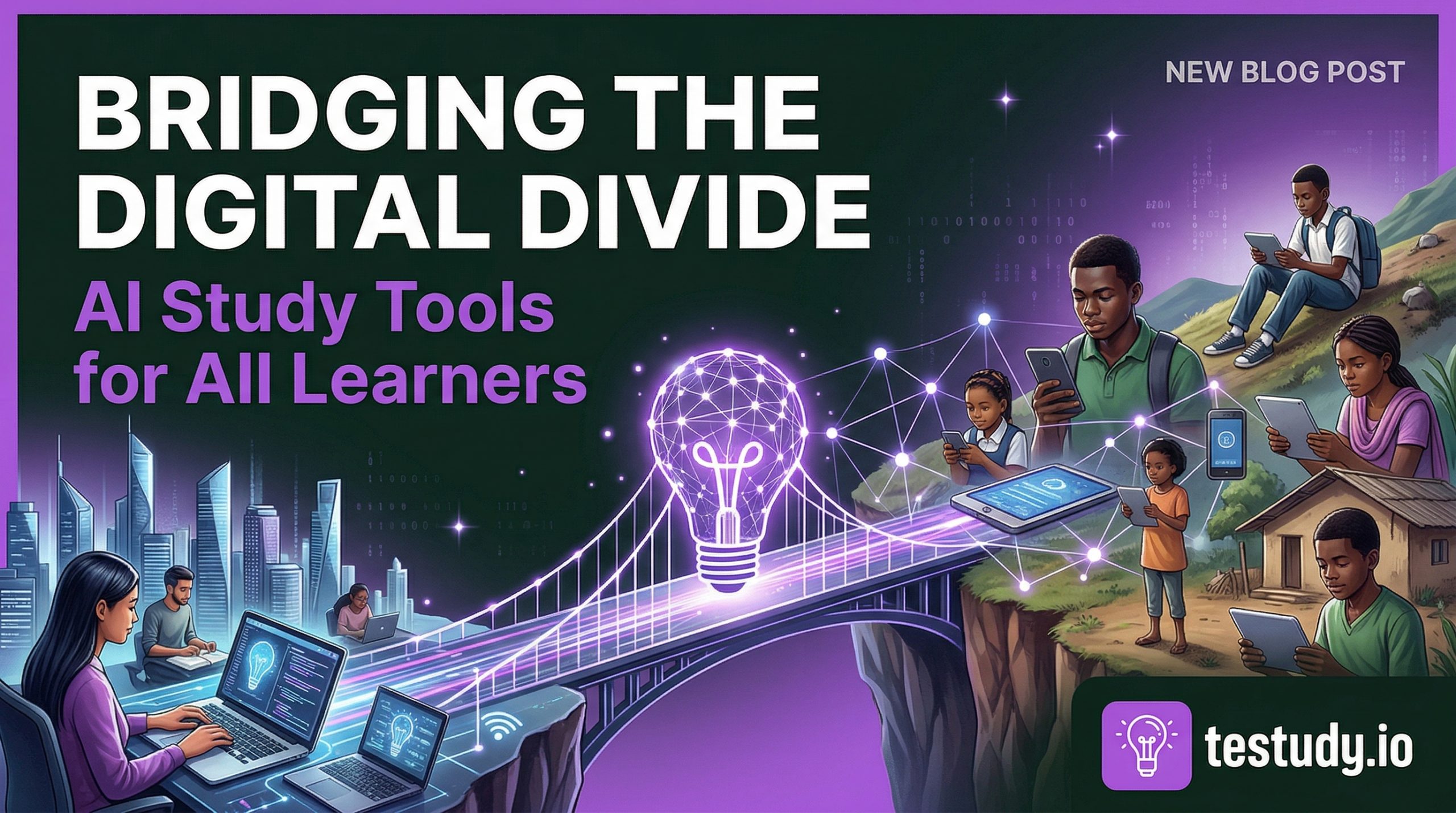
The potential of artificial intelligence to personalize education, tailoring study paths, generating practice questions, and optimizing review schedules is often discussed in the context of well-resourced classrooms and high-speed internet. For the billions of learners in underserved and remote communities, this promise frequently remains out of reach, not due to a lack of need, but due to a mismatch between sophisticated AI tools and the realities of low-bandwidth connections, basic devices, and diverse cultural contexts. The digital divide in learning is not just about access to a device; it’s about access to effective learning technology. This article argues that AI study tools can truly democratize education only if they are built from the ground up with a specific set of principles: offline-first functionality, optimization for low-cost hardware, deep cultural adaptation, and deployment through trusted local partnerships. The goal is not to create a ‘lite’ version of a premium product, but to design inherently more robust, focused, and contextually intelligent tools that work for everyone, everywhere.
1. Offline-First Architecture: Making AI Work Without Constant Connectivity
The most critical technical shift required is moving from a cloud-dependent model to an offline-first architecture. For a learner with intermittent or costly data, an AI tool that requires online access for every quiz or review session is unusable. An effective offline-first system operates on three layers: First, a local AI model (or a distilled version of it) must be capable of core functions like generating multiple-choice questions from stored text or calculating the next optimal review date based on the spaced-repetition algorithm. Second, the app must seamlessly queue all interactions, answers, progress, new content uploads, and sync them intelligently when a connection is detected, handling conflicts (e.g., if a quiz was taken offline and the answer key was updated online) gracefully. Third, the initial download and periodic content updates must be highly compressed and incremental. This approach respects the user’s data constraints while ensuring the learning process, the active recall and scheduling, is never interrupted. The AI’s intelligence is embedded in the device’s capability to manage the learning cycle, not in its need to call home for every decision.
2. Optimizing for the Devices People Actually Have
Designing for ‘the next billion user’ means designing for the device they own: typically an older, low-end Android smartphone with limited RAM, storage, and battery life. An AI study app cannot be a 500MB download that drains battery in an hour. Optimization requires ruthless prioritization. The core learning engine, question generation logic, spaced-repetition scheduler, local content storage, must be written in efficient code. Non-essential features (high-resolution images, complex animations, social feeds) should be optional or omitted. App size should be kept under 50MB where possible. The user interface must be navigable with minimal taps and readable on small, low-resolution screens. This constraint forces a focus on the fundamental learning interaction, stripping away the ‘bloatware’ that plagues many educational apps. The result is an app that is not just accessible but also faster and more reliable on any device.
3. Beyond Translation: The Deep Work of Cultural and Linguistic Adaptation
Translating the user interface from English to Swahili or Spanish is the easiest step. True localization is far more profound. It requires that the AI-generated study content itself is contextually relevant. A quiz question about ‘baseball innings’ makes no sense to a learner in a region where cricket or football is popular. Examples in math problems should use local currencies, measurements, and scenarios. Language models used for question generation must be fine-tuned on local educational curricula and vernacular to produce natural, appropriate phrasing. Furthermore, the concept of ‘correct’ answers and feedback must align with local pedagogical norms. In some cultures, direct correction is preferred; in others, a more suggestive, Socratic approach is effective. This adaptation cannot be an afterthought handled by a translation service; it must be built into the AI’s training data and content generation rules through collaboration with local educators and subject-matter experts.
4. Deployment is a Partnership, Not a Product Launch
A tech company cannot effectively reach isolated rural communities or navigate local education ministries alone. Sustainable deployment depends on strategic partnerships. NGOs on the ground provide trust, community relationships, and understanding of local needs. Government education departments can integrate tools into national programs or school systems, providing scale. Community organizations ensure cultural buy-in and can train local facilitators. These partners are not just distribution channels; they are co-designers. They provide feedback on what works, help adapt content, and support users. For the AI tool provider, this means building APIs and admin panels that allow partners to curate content, manage user groups offline, and access anonymized learning analytics in simple formats. The business model may involve providing the platform at low or no cost to these anchor partners, with sustainability coming from grants, government contracts, or premium features for other markets.
5. Measuring What Matters: Learning Outcomes, Not Just Logins
In a resource-constrained setting, vanity metrics like ‘number of downloads’ are meaningless. The true measure of impact is learning efficacy. This requires a different analytics framework. Key metrics include: Retention: Are learners remembering material over weeks and months, as measured by spaced-repetition success rates? Engagement Depth: Are they using the active recall features, or just passively reading? Skill Application: Can they apply knowledge in new contexts (assessed via scenario-based questions)? Equity of Outcome: Are performance gaps between different demographic groups (e.g., gender, location) narrowing? Collecting this data offline-first means designing for local storage and batch upload, respecting privacy regulations like GDPR even in low-resource contexts. The focus must be on longitudinal studies that track actual mastery, not just app opens.
Conclusion
Building AI study tools for the digital divide is not a charitable side project; it is a rigorous design challenge that forces innovation in efficiency, resilience, and cultural intelligence. The principles of offline-first operation, device optimization, deep localization, and partnership-led deployment are not compromises. They are the blueprint for creating truly accessible and effective educational technology. When an AI learning tool can function perfectly on a $50 smartphone with no signal, using examples a child in a remote village understands, and helping them master a curriculum relevant to their future, it ceases to be a tool for the ‘underserved’ and becomes simply a better, more universally designed tool. The ultimate measure of success for EdTech should be whether its most sophisticated features are available to the learner with the fewest resources. That is the standard for genuine educational equity.
Food for Thought
Consider a learning objective you are familiar with. How would you need to adapt the examples and questions for a learner in a completely different cultural and resource context?
If you were forced to remove 80% of your current study app’s features to make it work offline on a basic phone, which 20% would you keep and why? This reveals what is truly essential for learning.
Think about a technology deployment you’ve seen fail in a community. Was the failure primarily technical, or was it a lack of trusted local partnership and contextual understanding?
When measuring the success of a learning tool, what single metric would you choose to prove it is genuinely improving a learner’s life, not just their screen time?
Frequently Asked Questions
Does ‘offline-first’ mean the AI is less intelligent or limited?
No. It means the AI’s intelligence, its ability to generate questions, adapt pathways, and schedule reviews, is packaged to run locally on the device. The model may be optimized (smaller, distilled) for efficiency, but its core pedagogical functions remain intact. The limitation is on real-time data aggregation, not on the learner’s immediate experience.
How can we ensure cultural adaptation is authentic and not stereotypical?
Through continuous co-design with local stakeholders. This involves hiring and empowering local curriculum developers, educators, and linguists to curate and validate content. It means using region-specific datasets to train models and conducting user testing in the target communities. Authentic adaptation is an ongoing process, not a one-time translation task.
What is the biggest technical hurdle in implementing offline sync?
Conflict resolution. If a student takes a quiz offline and answers a question, but the teacher (or system) has updated the correct answer online in the meantime, the app must have a clear, transparent rule for resolving this (e.g., ‘teacher’s answer overrides,’ ‘most recent wins,’ or ‘flag for review’). Designing a simple, trustworthy sync conflict system is complex but essential for data integrity.
Are partnerships with governments too slow and bureaucratic for agile tech development?
They can be, which is why the partnership strategy must be dual-track. Work with agile NGOs and community groups for rapid iteration and local feedback. Simultaneously, engage government entities with clear evidence of efficacy (pilot data) and a product that meets their procurement and security standards. The NGO work de-risks the government engagement by providing proof of concept.
How do we fund the development of such specialized, constrained tools?
Through a combination of impact investing, development grants (from foundations, development banks), and cross-subsidization. The advanced, high-bandwidth version of the tool for affluent markets can subsidize the development of the offline-optimized, culturally adaptive version. The key is to treat the equity-focused product as a core engineering challenge, not a philanthropic add-on.