Key Takeaways
- Habits form through repeated cue-routine-reward cycles in consistent context, not through willpower alone.
- AI personalizes study cues by analyzing your behavior patterns (time, location, focus, success) rather than relying on static reminders.
- Effective gamification reinforces habits by providing immediate, competence-based rewards, not just extrinsic points.
- Missing a cue occasionally doesn’t break a habit; consistency over time matters more than perfection.
- Integration with calendar, wearables, and location services makes cues contextually appropriate and hard to ignore.
- The goal is to make studying automatic, freeing mental energy for actual learning rather than decision-making.
- AI assists habit formation but doesn’t replace intrinsic motivation; it optimizes the execution of existing intent.
Introduction
You’ve probably experienced this: you set a study schedule with full motivation, stick to it for a week, then life happens and your books gather dust. The problem isn’t you; it’s that you’re trying to use willpower to power through something that should be automatic. What if your study sessions could feel as natural as brushing your teeth? That’s the promise of understanding and applying the habit loop, especially when augmented by AI. This isn’t about working harder; it’s about designing systems where effective study happens with minimal conscious effort. We’ll break down the science of habit formation, show where most people get stuck, and explain how intelligent systems can personalize and reinforce your study routine until it becomes second nature.
Why Your Study Habits Keep Failing (And What the Habit Loop Reveals)
Most study habit attempts fail because they focus on the wrong lever: willpower. Willpower is a finite resource that depletes with use, relying on it to study after a long day is like expecting a drained battery to power your phone. The habit loop, popularized by Charles Duhigg, offers a more reliable framework. It consists of three elements: a cue (trigger), a routine (the behavior), and a reward (benefit). What makes habits powerful is that, through repetition, the behavior becomes automatic, requiring little cognitive energy. In learning contexts, this means your study session should start almost without decision. The problem? Most people set vague intentions (‘I’ll study more’) without designing clear cues and satisfying rewards. They also misunderstand what a cue is: it’s not just a time on the calendar, but a specific context like finishing dinner, sitting at your desk, or hearing a particular sound. Without a consistent, identifiable cue, the behavior never gets automatized. This is where traditional study advice falls short: it tells you to ‘be disciplined’ but doesn’t engineer the conditions for discipline to become unnecessary.
The Three Components of a Study Habit: Cue, Routine, Reward
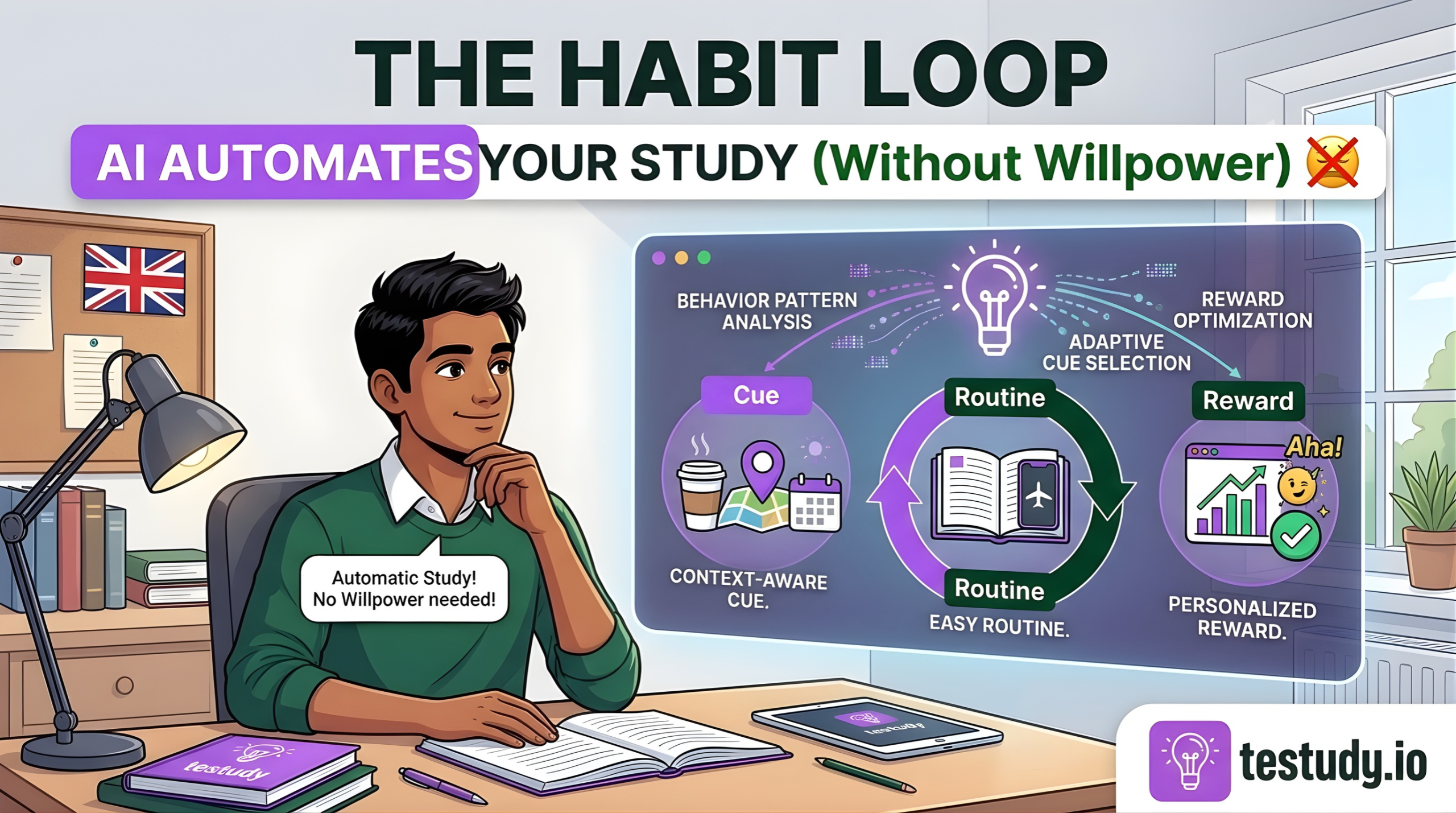
Let’s make this concrete. A study habit loop might look like this: Cue: After lunch (time + context), you always open your textbook (location + preceding action). Routine: You do 25 minutes of active recall using flashcards. Reward: You get a small dopamine hit from checking off a completed session in your tracker, plus the longer-term reward of feeling prepared. The cue must be specific and consistent. ‘At 3pm’ is weak; ‘After I pour my afternoon tea, at my desk, with phone on airplane mode’ is strong. The routine should be simple and bounded, 25 minutes is easier to automate than ‘study until I’m done.’ The reward must be immediate and certain; delayed rewards (like a good grade) don’t reinforce the loop effectively because the brain discounts future outcomes. Here’s where confusion often arises: people think the reward must be external (a snack, a break). While those work, the most sustainable rewards are internal: the satisfaction of completion, the ‘aha’ moment of recalling something correctly, or visual progress in a tracker. The key is the reward must follow the routine reliably and feel pleasurable. If you skip the reward, the loop weakens. Notice also that the cue is context-dependent: if you always study in the same place at the same time, the environment itself becomes part of the cue. This is why changing study locations can disrupt habits, the context signal is missing.
Beyond Simple Reminders: How AI Personalizes Your Study Cues
Now, what if your cue could adapt to your actual life? Static time-based reminders (‘Study at 5pm’) ignore your real rhythms. Some days you’re sharp after a walk; other days you’re fried after meetings. AI-powered systems like Testudy move beyond simple timers by analyzing multiple signals: your historical focus patterns (when you actually retain information), your location (home vs. office vs. library), your preceding activities (did you just exercise? have a stressful call?), and your recent success rate on material. The AI doesn’t just pick a time, it identifies the context in which you’re most likely to succeed and prompts you accordingly. For example, it might learn that after your morning coffee on weekdays, you have 30 minutes of high-focus time, but on weekends, you study better after a walk. So your cue becomes context-rich: ‘You’re at your desk with coffee, this is your optimal window for Chapter 3.’ This personalization matters because habit formation depends on consistent context. If the system respects your actual patterns, you’re more likely to follow through, and the loop strengthens. The AI essentially acts as a habit coach that knows you better than you know yourself, it detects patterns you might miss. But it’s not magic: it needs initial data (a couple of weeks of logging study sessions) and it refines as you give feedback (skipping or completing suggested sessions).
Gamification Done Right: Rewards That Strengthen, Not Undermine, Motivation
Here’s a critical nuance: adding points and badges can backfire. The over-justification effect (Deci & Ryan) shows that when you attach extrinsic rewards to an already intrinsically motivating activity, people can lose their original interest. So why do many study apps use gamification? Because poorly designed gamification focuses on collection (earn 500 points!) rather than competence. Well-designed systems, however, use game elements to provide immediate feedback and a sense of mastery, which are actually intrinsic needs. For example, a ‘streak’ counter isn’t just a badge; it visually represents consistency, satisfying the need for competence. A ‘level up’ after mastering a topic signals growth. The key is that rewards must be informational, not just transactional. They should say: ‘You are making progress’ rather than ‘You’ve earned a trinket.’ Testudy’s approach, for instance, ties rewards to active recall success and spaced repetition milestones, directly linked to learning outcomes. This reinforces the routine’s value without substituting it. Also, variable rewards (unpredictable praise or bonus points after a hard session) can strengthen habit loops more than fixed rewards, because unpredictability triggers dopamine release. But caution: if the game elements become the focus (‘I’m studying to get points, not to learn’), intrinsic motivation erodes. The design must keep learning as the core activity and gamification as a subtle enhancer.
Real Habit Transformations: How Adaptive Scheduling Builds Consistency
Let’s look at how this plays out. Consider ‘Alex,’ a law student with erratic study patterns, cramming before exams, then burning out. After using an AI-driven system for three months, their study behavior transformed. Initially, the AI noted Alex studied best in 45-minute blocks between 8-10am, but only on days after a gym session. The system set cues that combined time, location (home office), and preceding event (‘post-workout’). The routine was a 45-minute focused quiz session. The immediate reward was a visual completion marker plus a short, enjoyable break. Over weeks, the AI adjusted: when Alex’s course load changed, it shifted cue timing; when Alex missed a cue due to a late class, it didn’t penalize but rescheduled within the same contextual window (e.g., ‘You’re home now, this is your cue’). The result wasn’t perfect consistency (about 80% adherence), but that was enough to make study automatic. The stress of ‘deciding to study’ vanished because the cue triggered the routine almost reflexively. Another case: ‘Maya,’ a language learner, struggled with daily practice. The AI noticed she consistently practiced during her commute via phone. It set a cue triggered by her phone connecting to her car’s Bluetooth. The routine was a 10-minute vocabulary quiz. The reward was a ‘streak’ counter and a celebratory animation after five consecutive days. Within a month, practicing on the commute became habitual, she no longer had to motivate herself. These transformations share a pattern: the AI didn’t create motivation; it automated the execution of existing intention by optimizing the habit loop’s components.
Seamless Integration: Connecting AI Cues to Your Calendar, Watch, and Environment
A habit loop lives or dies by cue reliability. If your phone is on silent, you miss the notification. If you’re away from your desk, the cue doesn’t trigger. That’s why integration with your existing digital ecosystem is crucial. AI-driven study systems can sync with Google Calendar to avoid conflicts, use wearable data (like heart rate variability) to suggest study when you’re calm and focused, and leverage location services to cue you when you’re in your usual study spot. For example, if your calendar shows a free 30-minute block at 2pm and your smartwatch indicates low stress, the AI might send a gentle notification: ‘Optimal study window now, review Chapter 4 flashcards?’ Integration reduces friction: you don’t have to open an app to see your cue; it appears in your calendar or on your watch face. This is about meeting you in your flow state. But integration must be optional, some users prefer minimal notifications. The system should allow you to set boundaries (e.g., ‘Only cue me on weekdays before 6pm’). The goal is to make the cue contextually appropriate and hard to ignore, without being intrusive. When the cue is seamlessly woven into your existing routines (like checking your watch after a meeting), adoption becomes effortless.
Building Your Own AI-Assisted Habit Loop: Practical Steps
You don’t need to build an AI system to apply these principles, but using one accelerates the process. Here’s how to set up your loop: First, identify your existing patterns. For a week, log when you naturally feel focused and when you actually study. Look for contextual anchors, times, locations, preceding actions that recur. Second, define a tiny, specific routine. Instead of ‘study biology,’ try ‘do 10 flashcards on cell biology.’ The routine must be doable in under 5 minutes initially to ensure success. Third, choose an immediate, satisfying reward. This could be a physical token (move a coin from one jar to another), a digital check mark, or a 2-minute enjoyable break. The reward must follow immediately. Fourth, if using an AI tool, input your initial preferences and let it observe. Don’t override its suggestions for at least two weeks, let it learn your patterns. Fifth, track adherence but not perfection. Aim for 70% consistency; missing a cue isn’t failure, it’s data for the AI. Sixth, review monthly: are you studying more automatically? Is the stress of starting decreasing? Adjust cues or routines if needed. Remember: the loop strengthens through repetition in consistent context. The AI’s job is to find that context and cue you there reliably.
Conclusion: From Forced Discipline to Automatic Learning
Effective learning shouldn’t feel like constant uphill battle. The science of habit loops shows us that by designing clear cues, simple routines, and immediate rewards, we can make study behavior automatic—freeing mental bandwidth for actual learning. AI doesn’t replace your effort; it eliminates the decision fatigue and context-switching that sabotage good intentions. By personalizing cues to your real life, using gamification to provide meaningful feedback, and integrating with your digital world, these systems help you build a sustainable learning practice. The ultimate goal isn’t to study more hours, but to make the hours you do study more consistent, focused, and effective. Start by observing your current patterns, then let technology handle the scheduling nudges. Over time, you’ll find yourself studying not because you ‘have to,’ but because the cue triggers the routine almost without thought—and that’s when true mastery begins.
Conclusion
The habit loop is a powerful lens for understanding why some study routines stick and others don’t. By focusing on context-rich cues, manageable routines, and immediate rewards, you can transform studying from a chore into an automatic part of your day. AI enhances this by personalizing cues to your unique patterns and reducing the friction of initiation. But remember: the technology is an assistant, not a replacement for your intrinsic motivation. Use it to remove the barriers, not to bypass the work of learning. When the habit loop runs smoothly, you’ll experience what it means to study smarter, not because you’re pushing harder, but because the system is working for you. That’s the promise of habit-aware learning tools: they don’t just help you pass a test; they help you become a lifelong learner.
Food for Thought
Think about a current study routine that feels forced. What is the cue? Is it specific and context-rich, or vague like ‘after work’?
When you miss a study session, what usually interrupts the cue? Could that context be modified or avoided?
What immediate reward do you give yourself after studying? Does it feel satisfying and certain, or is it delayed (like thinking about future grades)?
Do you ever feel gamified elements (streaks, points) are pushing you to study for the wrong reasons? How could they be redesigned to support your learning goals?
If an AI analyzed your study patterns, what might it notice about your optimal focus times and contexts that you haven’t consciously recognized?
Frequently Asked Questions
How long does it realistically take to form a study habit using the habit loop?
Research shows significant variability, anywhere from 18 to 254 days, with an average of 66 days (Lally et al., 2010). The complexity of the behavior and your consistency matter more than a fixed timeline. With AI assistance, you may form the habit faster because cues are better personalized and you get immediate feedback, but don’t expect overnight change. Focus on showing up consistently for 2-3 months, and the behavior will increasingly feel automatic.
Can AI really understand my personal schedule and preferences better than I do?
AI doesn’t ‘understand’ in a human sense, but it can detect patterns in your behavior data (study times, duration, success rates, location) that you might not consciously notice. For example, it might realize you consistently study better after a 20-minute walk, even if you never made that connection. It then uses these patterns to suggest cues that align with your natural rhythms. However, AI works best when you provide initial input and occasional feedback, it’s a collaboration, not a replacement for self-awareness.
What if I miss a cue or break my streak? Does that ruin the habit?
No. Habits are resilient. Missing once or twice doesn’t erase neural pathways. What matters is overall consistency over time. AI systems typically account for this by not resetting streaks for a single miss and by rescheduling within the same contextual window. The key is to return to the routine quickly. A ‘slip’ is data, not failure. The habit loop strengthens through repeated pairings of cue-routine-reward; occasional misses don’t break the chain if you resume promptly.
How is AI-powered habit formation different from just setting calendar reminders?
Calendar reminders are static and time-based. AI-powered systems use multiple signals: your past focus patterns, location, preceding activities, and even physiological data (if integrated with wearables) to determine the optimal moment for a cue. They also adapt over time, if you consistently ignore a 5pm cue, the AI might shift it to 6pm or tie it to a different context (like ‘after dinner’). Additionally, AI connects the cue to your actual performance data, adjusting difficulty and reward timing to keep you in the zone of proximal development. It’s not just ‘remind me at 5pm’; it’s ‘remind me when you’re most likely to succeed, based on your history.’
Is gamification just a gimmick, or does it actually support habit formation?
It can be either, depending on design. Gimmicky gamification adds points and badges without connection to the behavior, which can undermine intrinsic motivation. Effective gamification provides immediate feedback (you got 8/10 correct!), signals progress (you’ve mastered 50% of this deck), and satisfies psychological needs for competence and autonomy. The reward should feel like a natural consequence of the routine, not an external bribe. When designed well, gamification elements like streaks, levels, and visual progress trackers reinforce the habit loop by making the reward immediate and tangible. Look for systems where game elements are tied directly to learning outcomes, not just time spent.
Do I need to use a specific app like Testudy to apply these principles, or can I do this manually?
You can apply the habit loop principles manually: identify a consistent cue (e.g., ‘after my morning coffee’), define a tiny routine (e.g., ‘review 5 flashcards’), and give yourself an immediate reward (e.g., ‘check a box on a paper tracker’). However, AI tools accelerate the process by automatically personalizing cues based on your data, adjusting difficulty, and integrating with your calendar and devices. They also remove the guesswork and decision fatigue. If you’re tech-savvy and disciplined, manual habit design can work. For most people, an AI assistant reduces friction and provides the consistency needed to form habits faster.
What if I’m not motivated to study at all? Can habit loops create motivation?
Habit loops automate behavior, but they don’t generate motivation from nothing. They work best when you have at least a moderate initial intention to study. The loop turns ‘I should study’ into ‘I study automatically when X happens.’ If you have zero motivation, start by connecting the routine to a deeper value (e.g., ‘I study because I want to become a doctor’) and use the reward to reinforce small wins. AI can help by suggesting very tiny routines (2 minutes) that are hard to refuse, building momentum. But if you’re deeply resistant, examine whether the goal is truly yours or if burnout/anxiety is present, habit formation alone won’t fix those underlying issues.